Most Salesforce projects stop at creating custom objects, validation rules, and a few automations. I wanted to challenge myself to think beyond Salesforce and understand how multiple enterprise systems work together.
That curiosity led me to build PR3: Nexus Global Enterprise Compliance Hub, my most ambitious project so far.
The idea was simple at first. I wanted to simulate how a large multinational company could monitor compliance issues across global offices and automatically coordinate actions across multiple departments.
However, the project quickly evolved into something much bigger.
Instead of building a standalone Salesforce solution, I started building an entire ecosystem.
The Business Scenario
Imagine a global organization operating across multiple countries. One office suddenly enters a critical compliance state.
In many organizations, this process is still manual.
Someone notices the issue.
Someone sends an email.
Someone updates a spreadsheet.
Someone creates a ticket.
Someone eventually follows up days later.
This creates delays, communication gaps, and unresolved risks.
I wanted to eliminate these manual handoffs.
My goal was to build an event-driven enterprise ecosystem where systems communicate automatically.
Planning Like an Enterprise Architect
Before opening Salesforce, I wanted to approach this differently.
I created Jira projects to simulate requirement gathering.
I built user stories for different stakeholders.
A Compliance Officer needed accurate compliance monitoring.
A Global CEO needed centralized visibility.
A Logistics Manager needed operational oversight.
I also created Confluence documentation to design the technical architecture before implementation.
This was my first attempt at treating a personal project like a real enterprise implementation instead of a learning exercise.
Building the Salesforce Foundation
Salesforce became the heart of the system.
I created a custom object called Global Office to manage worldwide office information.
Each office contained compliance information, tax identifiers, parent corporation relationships, Salesforce references, and Jira references.
I created records for multiple countries to simulate a global environment.
This transformed Salesforce from a CRM into an operational command center.
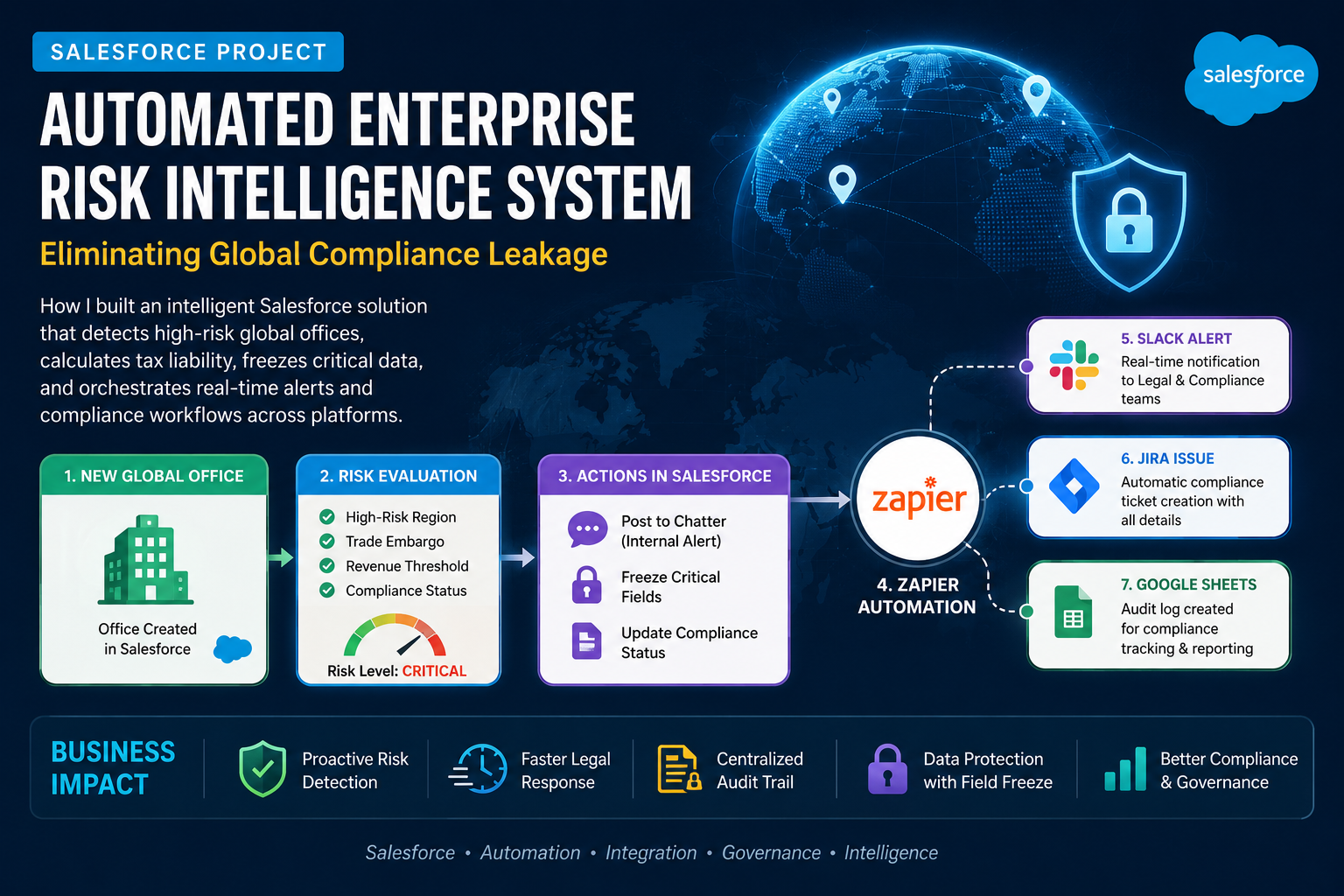
Building an Event-Driven Ecosystem
The entire architecture revolved around one condition.
Whenever a Global Office became 🔴 CRITICAL, the automation ecosystem started working.
Salesforce sent information into Zapier.
Zapier distributed notifications into Slack.
Google Sheets stored external audit logs.
The system waited seven days before checking Salesforce again.
If the issue remained unresolved, Outlook sent escalation emails and Jira created incident tickets.
What fascinated me was seeing previously disconnected systems behave like one unified application.
Connecting Salesforce and Jira
One of my favorite parts of this project was creating two-way navigation between Salesforce and Jira.
Salesforce stores Jira references.
Jira stores Salesforce references.
This allows users to jump between both systems during investigations.
Although it sounds simple, this small improvement creates a much smoother experience for teams.
Experimenting With Power Automate Desktop
I also wanted to explore Robotic Process Automation.
My objective was to automate Excel report generation and convert reports into PDFs.
This turned out to be much harder than expected.
I encountered file lock issues, macro execution failures, synchronization problems, and window detection errors.
Initially, these felt frustrating.
Eventually, I realized these failures were valuable learning experiences.
Real engineering projects rarely work perfectly the first time.
Troubleshooting became an important part of the project itself.
What This Project Taught Me
This project changed the way I think about technology.
I no longer see Salesforce as a standalone application.
I now see it as a central platform that can orchestrate an entire ecosystem.
I also learned that architecture is not about building one giant automation.
It is about connecting many smaller systems that each perform a specific responsibility.
Most importantly, I learned that experimentation, failures, redesigns, and troubleshooting are normal parts of building enterprise solutions.
Technologies Used
Salesforce
Zapier
Jira
Confluence
Slack
Google Sheets
Microsoft Outlook
Microsoft Power Automate Desktop
Microsoft Excel
Final Thoughts
PR3: Nexus Global Enterprise Compliance Hub became much more than a portfolio project.
It became my first attempt at thinking like an enterprise architect.
Instead of focusing on one tool, I focused on how tools collaborate together.
That mindset completely changed how I approach building solutions.
This project represents my transition from learning individual technologies to designing connected systems that solve business problems.