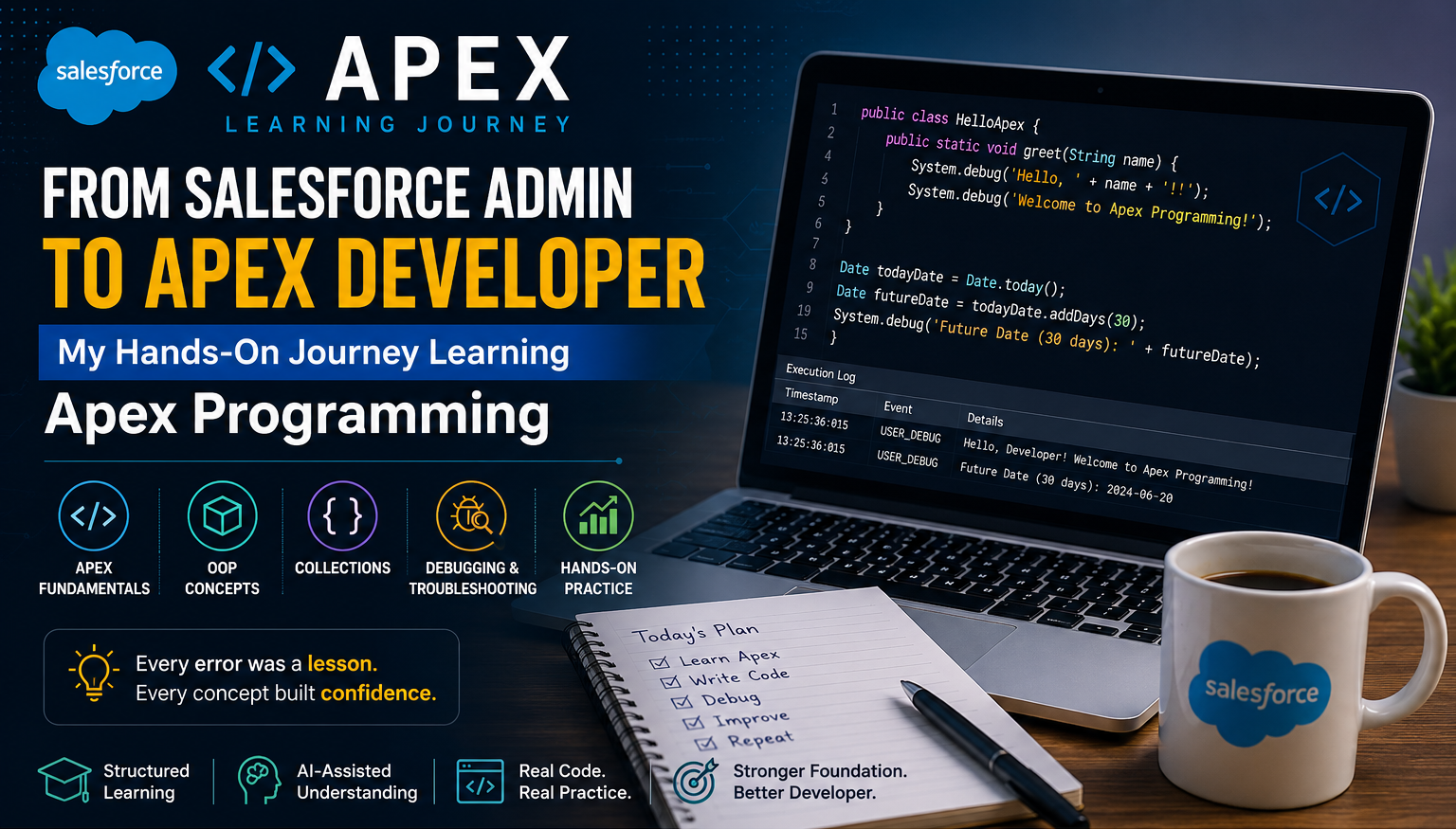
Over the past several months, I have been intentionally transitioning from Salesforce declarative tools into Salesforce development. After becoming comfortable with clicks-not-code solutions, I reached a point where I wanted to understand what happens behind the scenes and how developers build custom business logic inside Salesforce.
That decision led me into the world of Salesforce Apex.
This project was not simply about watching course videos or memorizing syntax. It became a practical learning journey where I experimented with code, made mistakes, encountered errors, and slowly developed confidence as a beginner Apex developer.
The experience taught me that becoming a Salesforce developer is less about writing perfect code and more about understanding how to think, troubleshoot, and continuously improve.
Why I Started Learning Apex
Salesforce is widely known for its declarative capabilities. Administrators can build applications, automate workflows, create reports, and customize objects without writing code.
However, I discovered that many real-world business requirements eventually reach a point where declarative tools alone are not enough.
I wanted to understand how developers solve these complex requirements.
My goal was not to become an expert overnight. My objective was much simpler: build a strong foundation and become comfortable reading, writing, and troubleshooting Apex code.
To achieve this, I followed a structured Apex Programming course and complemented it with AI-assisted learning sessions that allowed me to ask questions whenever I encountered obstacles.
This combination created a highly interactive learning environment.
My Learning Approach
Instead of passively consuming lessons, I created a repeatable learning system.
My workflow looked like this:
- Watch a lecture.
- Open Salesforce Developer Console.
- Replicate the code manually.
- Execute the code.
- Analyze errors.
- Search for explanations.
- Correct the mistakes.
- Document what I learned.
This process transformed every error message into a learning opportunity.
Rather than becoming frustrated when code failed, I slowly started treating errors as feedback from the system.
That mindset shift made a significant difference in my learning journey.
Understanding Apex Fundamentals
My first lessons focused on variables and primitive data types.
I learned that Apex is a strongly typed programming language. Every variable must be declared with a specific data type before it can be used.
I practiced working with:
- String
- Integer
- Decimal
- Boolean
- Id
At first, these concepts seemed straightforward, but they became the building blocks for everything that followed.
I also discovered the importance of System.debug().
This quickly became one of my favorite tools because it allowed me to inspect values and understand what my code was doing behind the scenes.
Working with Salesforce Date Methods
One of my earliest exercises involved manipulating dates.
I learned how to use:
- Date.today()
- addDays()
- addMonths()
- addYears()
Although these methods looked simple, they introduced me to Salesforce’s built-in utility functions and demonstrated how much functionality already exists within the platform.
I also encountered my first Developer Console challenge.
The auto-complete functionality was inconsistent and sometimes refused to appear.
Instead of relying entirely on automation, I learned to write code manually and use keyboard shortcuts to improve efficiency.
This experience taught me an important lesson: tools are helpful, but understanding the underlying concepts is far more valuable.
Learning to Think in Parent and Child Relationships
As I progressed further, I encountered nested loops.
Initially, nested loops looked intimidating.
However, once I understood Salesforce’s parent-child relationships, the concept became easier to visualize.
I learned how businesses often work with connected records such as:
- Accounts and Contacts
- Positions and Candidates
- Shipments and Cargo Items
Nested loops allowed me to process parent records and then iterate through related child records.
This topic also introduced me to one of Salesforce’s most important concepts: Governor Limits.
I learned that developers must always be conscious about system resources.
One lesson stood out clearly.
Never place SOQL queries or DML operations inside loops.
This principle will remain important throughout my Salesforce development journey.
Entering the World of Object-Oriented Programming
Object-Oriented Programming was the biggest milestone in this project.
Initially, the terminology itself felt overwhelming.
Classes.
Objects.
Methods.
Inheritance.
Polymorphism.
Encapsulation.
These were concepts I had heard before but never fully understood.
Fortunately, consistent practice began connecting the dots.
Building Classes and Objects
I created simple classes such as Dog, Employee, and Cat.
This taught me how to create blueprints for objects and then instantiate those objects within Execute Anonymous.
For example, creating a Dog object and assigning properties suddenly made programming feel more real and interactive.
Instead of abstract concepts, I was creating digital entities with their own attributes and behaviors.
This was one of the moments where coding started becoming enjoyable.
Learning Encapsulation
Encapsulation taught me how to protect data.
I learned that developers should not always expose variables directly.
Instead, data can be controlled through methods.
Using private variables and public setter methods introduced me to secure programming practices.
Although the examples were simple, they established a strong foundation for writing maintainable code in the future.
Understanding Inheritance
Inheritance was another breakthrough moment.
I built Vehicle and Truck classes to understand how child classes inherit behavior from parent classes.
Initially, I struggled with compiler errors.
One error repeatedly appeared:
“Illegal assignment from Truck to Vehicle.”
At first, the error felt confusing.
However, after carefully debugging the issue, I discovered that the parent class needed to be declared as virtual.
Once I corrected the class structure, everything worked as expected.
This experience reinforced an important lesson.
Programming is often about understanding why errors happen rather than avoiding errors entirely.
Discovering Polymorphism
Polymorphism introduced a completely new way of thinking.
I learned that one reference variable can point to different object types.
Seeing this behavior inside Salesforce Developer Console was exciting because it demonstrated how developers create flexible and reusable systems.
Although these examples were introductory, they provided a glimpse into how enterprise software architecture is built.
Working with Collections
I also learned how Salesforce stores and organizes data efficiently.
I practiced using:
Lists to store ordered records.
Sets to store unique values.
Maps to create key-value relationships.
Collections are fundamental to Salesforce development because developers constantly process large volumes of data.
Learning these structures early will help me write scalable code later in my journey.
The Role of AI in My Learning Process
One aspect that made this project unique was my AI-assisted learning workflow.
Instead of becoming stuck for hours, I used AI as a learning companion rather than a shortcut.
Whenever I encountered errors, I asked questions.
The conversations helped me understand concepts, debug syntax issues, and build confidence.
However, I intentionally avoided simply copying answers.
I used AI to understand the reasoning behind the solutions.
This approach accelerated my learning without replacing the actual hands-on work.
Challenges I Encountered
This project included numerous obstacles.
Some of the most memorable challenges were:
- Developer Console auto-complete inconsistencies.
- Variable does not exist errors.
- Incorrect method syntax.
- String concatenation mistakes.
- Class compilation issues.
- Inheritance configuration errors.
Every obstacle became part of the learning process.
Rather than hiding mistakes, I documented them because debugging is an essential developer skill.
What This Project Taught Me
This project represents an important milestone in my Salesforce journey.
I am no longer viewing Salesforce purely from an administrator perspective.
I am gradually developing the mindset of a Salesforce developer.
The biggest lesson I learned is that coding confidence does not come from perfection.
It comes from repetition.
Every execution, every error, every correction, and every successful output contributes to long-term growth.
This project also reminded me that learning technology is not a race.
Progress happens one concept at a time.
Today, I feel significantly more comfortable opening Salesforce Developer Console, reading Apex code, troubleshooting issues, and understanding object-oriented programming concepts.
Most importantly, I now have a solid foundation that will support future topics such as triggers, asynchronous processing, integrations, Lightning Web Components, and advanced Salesforce development.
This project is not the end of my Apex journey.
It is the beginning.