Introduction
Managing global operations is far more complicated than simply opening new offices in different countries.
As organizations expand internationally, they encounter new tax regulations, trade restrictions, compliance requirements, and operational risks that become increasingly difficult to manage manually.
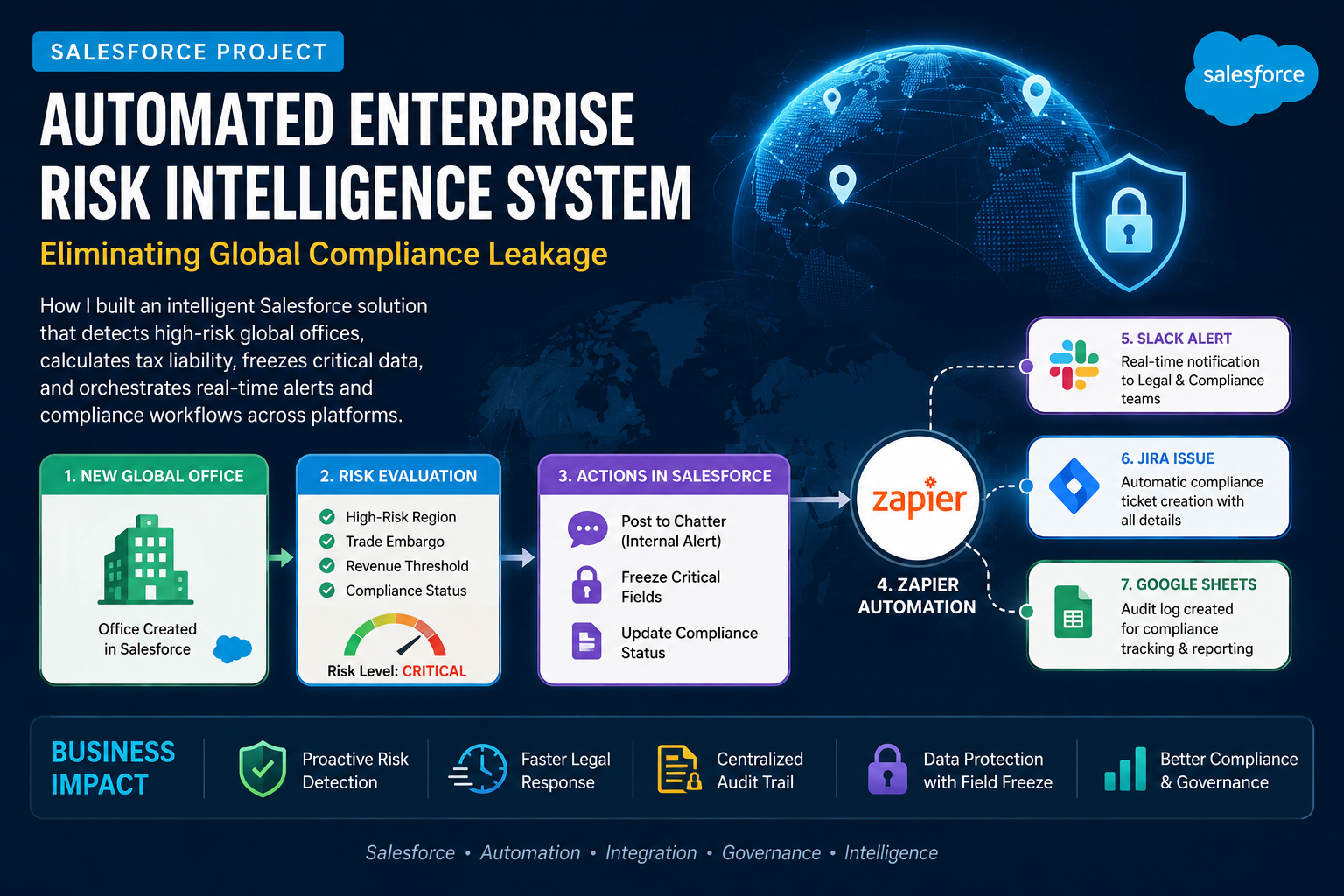
For this portfolio project, I designed an Enterprise Risk Intelligence System inside Salesforce to simulate how a multinational organization could automatically detect, classify, and escalate high-risk global office activities before they become major compliance issues.
This project transformed Salesforce from a traditional CRM into an intelligent governance platform capable of monitoring operational expansion across multiple countries.
The solution integrates Salesforce, Zapier, Slack, Jira, Chatter, and Google Sheets to build a complete risk management ecosystem.
The Business Problem: Global Expansion Creates Operational Paralysis
Imagine an enterprise with more than 20,000 global subsidiaries.
Every time a new office opens, multiple departments become involved.
- Finance teams need tax visibility.
- Legal teams need regulatory awareness.
- Compliance officers need governance controls.
- Corporate executives need centralized oversight.
Without automation, critical information remains trapped inside regional teams.
This creates operational paralysis.
Titan Global Enterprises, the fictional organization used in this case study, was facing several challenges.
Problems Identified
- High-risk offices could be created without immediate oversight.
- Trade embargo regions could be overlooked.
- Tax liabilities were difficult to monitor.
- Compliance teams received delayed information.
- Audit records were scattered across systems.
- Communication bottlenecks slowed response times.
- Sensitive data remained vulnerable to accidental modifications.
The organization required an intelligent, automated governance solution.
Project Objective
The objective was to create an automated enterprise risk management framework capable of:
- Monitoring global office creation activities
- Detecting high-risk jurisdictions
- Calculating tax liabilities automatically
- Classifying operational risks
- Protecting sensitive information
- Notifying stakeholders instantly
- Creating compliance tasks
- Maintaining audit trails
Solution Architecture
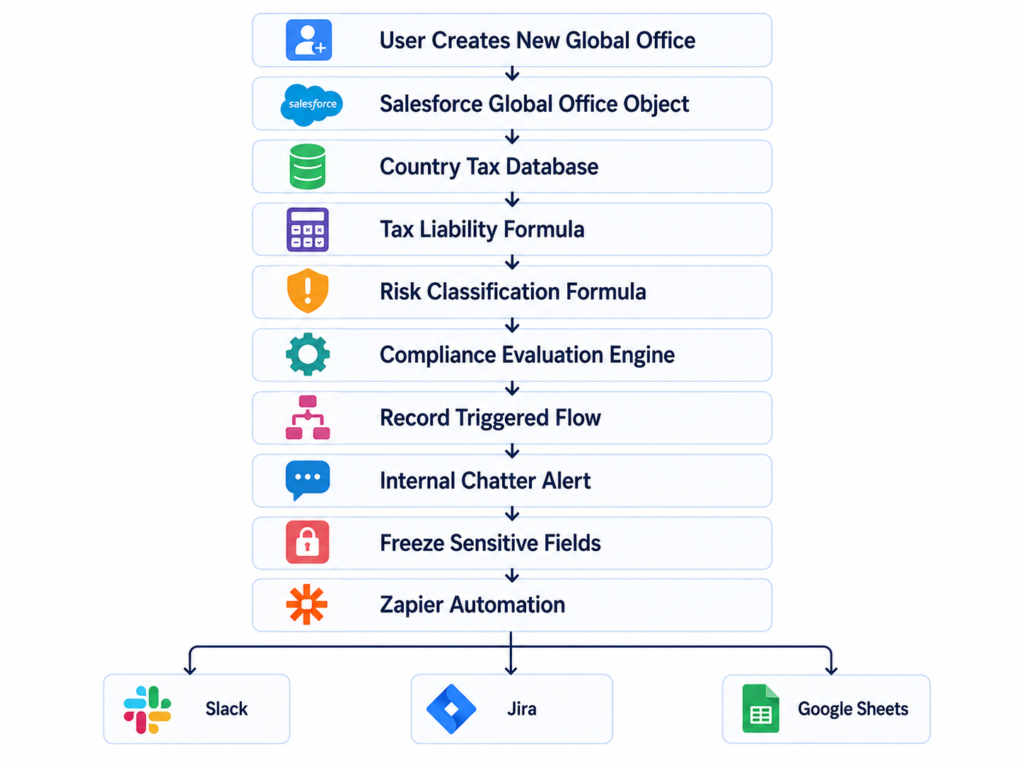
The entire process was built around event-driven automation.
Whenever a new Global Office record is created inside Salesforce, the system automatically evaluates multiple business conditions before triggering internal and external actions.
Building the Global Office Data Model
I created a custom Global Office object to represent international subsidiaries and regional offices.
Each office stores critical information required for governance and automation.
Fields Included
- Office Name
- Parent Corporation
- Tax ID
- Revenue Estimate
- Compliance Status
- Risk Level
- Global Flags
- Tax Liability
- Jira Key
- Salesforce Record Link
This data model acts as the foundation of the entire solution.
Building the Tax Intelligence Engine
One of the core components was country-based tax liability automation.
Instead of manually calculating taxes, Salesforce automatically references country information and calculates tax liabilities.
| Country | Tax Rate |
|---|---|
| India | 18% |
| Germany | 19% |
| UK | 20% |
| Singapore | 7% |
| UAE | 5% |
| Brazil | 25% |
This allows global offices to inherit tax calculations dynamically.
Creating the Risk Classification Engine
I built formula logic that evaluates geopolitical risks and operational thresholds.
If a location contains specific risk indicators, Salesforce immediately classifies it as critical.
Conditions Used
- High-Risk Region
- Trade Embargo
- Revenue Thresholds
Example logic:
IF

High Risk Region

OR

Trade Embargo

↓

CRITICAL

Else

Revenue > 1,000,000

↓

HIGH

Else

STANDARD
This enables proactive risk detection.
Automating Compliance Evaluation
I built a Record Triggered Flow that continuously evaluates office records.
The flow checks:
- Compliance status
- Risk level
- Revenue thresholds
- High-risk subsidiaries
When critical conditions are detected, escalation begins automatically.
Zero Trust Fiscal Freeze
One of my favorite parts of this project was implementing governance controls.
When an office reaches a critical status, sensitive information becomes protected.
Fields can no longer be modified until verification occurs.
Protected information includes:
- Revenue data
- Compliance fields
- Sensitive operational information
This preserves audit integrity.
Internal Alerting with Chatter
Before external systems activate, Salesforce immediately posts an internal alert.
Example:
🚨 TITAN RISK ALERT 🚨
A critical office asset has been initialized.
Estimated regional revenue has been detected.
Zero Trust Fiscal Freeze has been deployed.
Verification is required.
This ensures internal teams become aware before escalation spreads outside the platform.
Cross Platform Automation with Zapier
Zapier serves as the orchestration engine between Salesforce and external applications.
When Salesforce identifies a critical office, Zapier automatically distributes information to downstream systems.
Zapier actions include:
- Filtering critical events
- Sending Slack notifications
- Creating Jira issues
- Updating Google Sheets audit logs
This eliminates manual communication processes.
Slack Integration
The legal team receives immediate notifications whenever a critical office is created.
Information shared includes:
- Office Name
- Compliance Status
- Region
- Tax Information
- Parent Organization
- Creation Details
This significantly reduces response times.
Jira Compliance Workflow
Jira automatically creates a compliance task for investigation.
Each issue includes:
- Office information
- Compliance status
- Salesforce record reference
- Verification requirements
This creates accountability for governance teams.
Building an External Audit Trail
Google Sheets was used as an independent audit repository.
Every critical event is permanently logged.
Data captured includes:
- Office Name
- Country
- Revenue
- Risk Level
- Compliance Status
- Timestamp
This creates a secondary source of truth outside Salesforce.
Challenges I Faced During This Project
This project evolved significantly during development.
Initially, it started as a revenue and taxation project.
As additional business requirements emerged, it evolved into a much larger enterprise governance solution.
One challenge was preventing scope creep and keeping the project focused.
I eventually reorganized the project around a single theme:
Enterprise Risk Intelligence and Compliance Governance.
That decision made the architecture much cleaner.
Skills Demonstrated
Salesforce
- Custom Objects
- Formula Fields
- Record Triggered Flows
- Chatter Automation
- Data Modeling
Integrations
- Zapier
- Slack
- Jira
- Google Sheets
Business Skills
- Enterprise Architecture
- Compliance Governance
- Risk Management
- Operational Intelligence
- Process Automation
Final Thoughts
This project taught me that Salesforce can become much more than a CRM.
With the right architecture, Salesforce can evolve into an Enterprise Risk Intelligence Platform capable of protecting multinational organizations from operational paralysis, compliance leakage, and delayed decision-making.
By combining automation, governance, and integrations, organizations can proactively identify risks before they become costly business problems.
This project represents my approach to designing enterprise solutions that connect business processes with intelligent automation.