Executive Summary
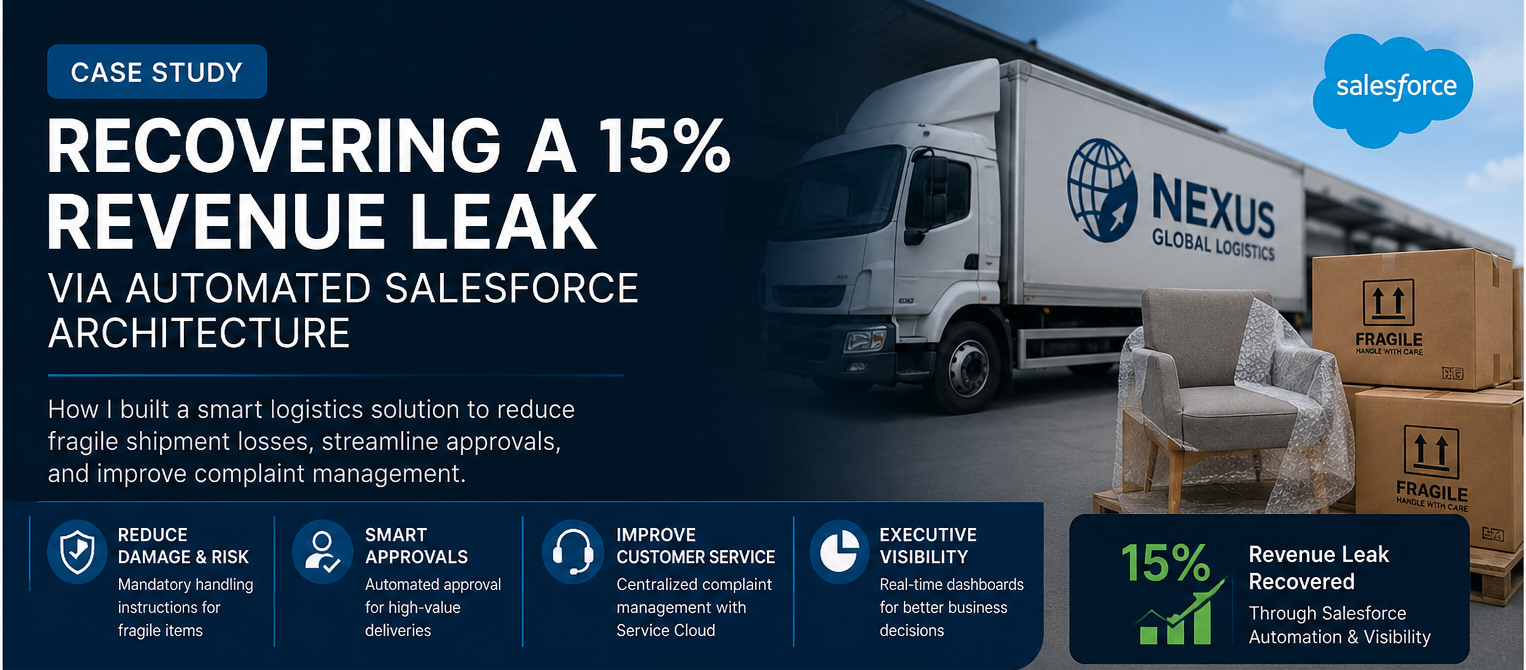
A logistics company specializing in high-value furniture deliveries was losing approximately 15% of revenue due to damaged fragile shipments, inefficient complaint handling, and manual approval bottlenecks.
To address these challenges, I designed and implemented a Salesforce-based logistics management solution using custom objects, automation, approval processes, Service Cloud cases, and executive dashboards.
The solution centralized delivery operations, enforced fragile shipment controls, improved complaint visibility, and introduced governance for high-value deliveries.
Client Background
Nexus Global Logistics is a premium logistics provider responsible for transporting fragile and high-value furniture products.
As shipment volumes increased, operational processes became increasingly manual and difficult to manage.
Management identified three major concerns:
- Fragile shipment damage
- Complaint resolution inefficiencies
- Approval delays
These issues directly affected revenue, customer satisfaction, and operational efficiency.
The Business Challenge
Challenge 1: Fragile Shipment Damage
Warehouse teams could identify fragile items, but there was no system enforcement requiring handling instructions.
Consequences included:
- Inconsistent packaging
- Improper transportation
- Damaged products
- Replacement costs
Estimated impact:
15% revenue leakage through refunds and replacement expenses.
Challenge 2: Complaint Visibility
Customer complaints were tracked through disconnected channels.
Management lacked visibility into:
- Which deliveries generated complaints
- Which products were repeatedly damaged
- Which operational processes were failing
Challenge 3: Approval Overload
Every delivery required management review.
This created:
- Delayed approvals
- Operational bottlenecks
- Inefficient use of management time
Solution Strategy
Rather than solving each problem separately, I designed a centralized Salesforce architecture that connected customers, deliveries, delivery items, and complaints into a single system.
Core design principles:
- Single source of truth
- Strong data integrity
- Automation over manual processes
- Executive visibility
Salesforce Architecture
Account
│
▼
Delivery
│
▼
Delivery Item
Delivery
│
▼
Case (Complaint)
Account → Delivery
Reason:
Customer records and delivery records require independent lifecycles.
Why Master-Detail Was Used
Delivery → Delivery Item
Reason:
Delivery items cannot exist without a parent delivery.
Benefits:
- Roll-up summaries
- Security inheritance
- Data integrity
Key Salesforce Features Implemented
Custom Delivery Management
Created a custom Delivery object to track shipments and delivery status.
Delivery Item Tracking
Created a Delivery Item object to track products individually.
Roll-Up Summary Fields
Implemented:
- Total Delivery Value
- Fragile Item Count
These provided real-time visibility into shipment risk and value.
Validation Rules
Implemented a validation rule requiring handling instructions whenever a product is marked as fragile.
Business outcome:
Prevented shipments from leaving the warehouse without documented handling guidance.
Approval Process
Designed an approval workflow for deliveries exceeding $50,000.
Business outcome:
Managers review only exceptional cases.
Complaint Management
Linked Service Cloud Cases to Delivery records.
Business outcome:
Support agents gained instant access to shipment history and fragile item information.
Reports and Dashboards
Created executive dashboards to monitor:
- Delivery value by status
- Fragile shipment exposure
- Complaint trends
- Approval activity
This enabled real-time operational monitoring.
Testing and Validation
Summarize four test scenarios:
| Test Scenario | Expected Result | Outcome |
|---|---|---|
| Roll-Up Summary | Correct totals | Pass |
| Fragile Validation | Error displayed | Pass |
| Approval Process | Trigger approval | Pass |
| Complaint Linking | Relationship created | Pass |
Results
Revenue Protection
Reduced risk associated with fragile shipments through mandatory handling controls.
Operational Efficiency
Automated approval processes reduced management workload.
Customer Experience
Structured complaint tracking improved service visibility and resolution speed.
Data Quality
Strong object relationships improved reporting accuracy.
Executive Visibility
Dashboards provided real-time business insights.
Key Skills Demonstrated
- Salesforce Administration
- Data Modeling
- Service Cloud
- Validation Rules
- Approval Processes
- Reporting & Dashboards
- Business Analysis
- Solution Architecture
Lessons Learned
This project reinforced the importance of designing Salesforce solutions around business outcomes rather than platform features.
The most valuable lesson was understanding how data modeling decisions influence reporting, automation, user experience, and long-term scalability.