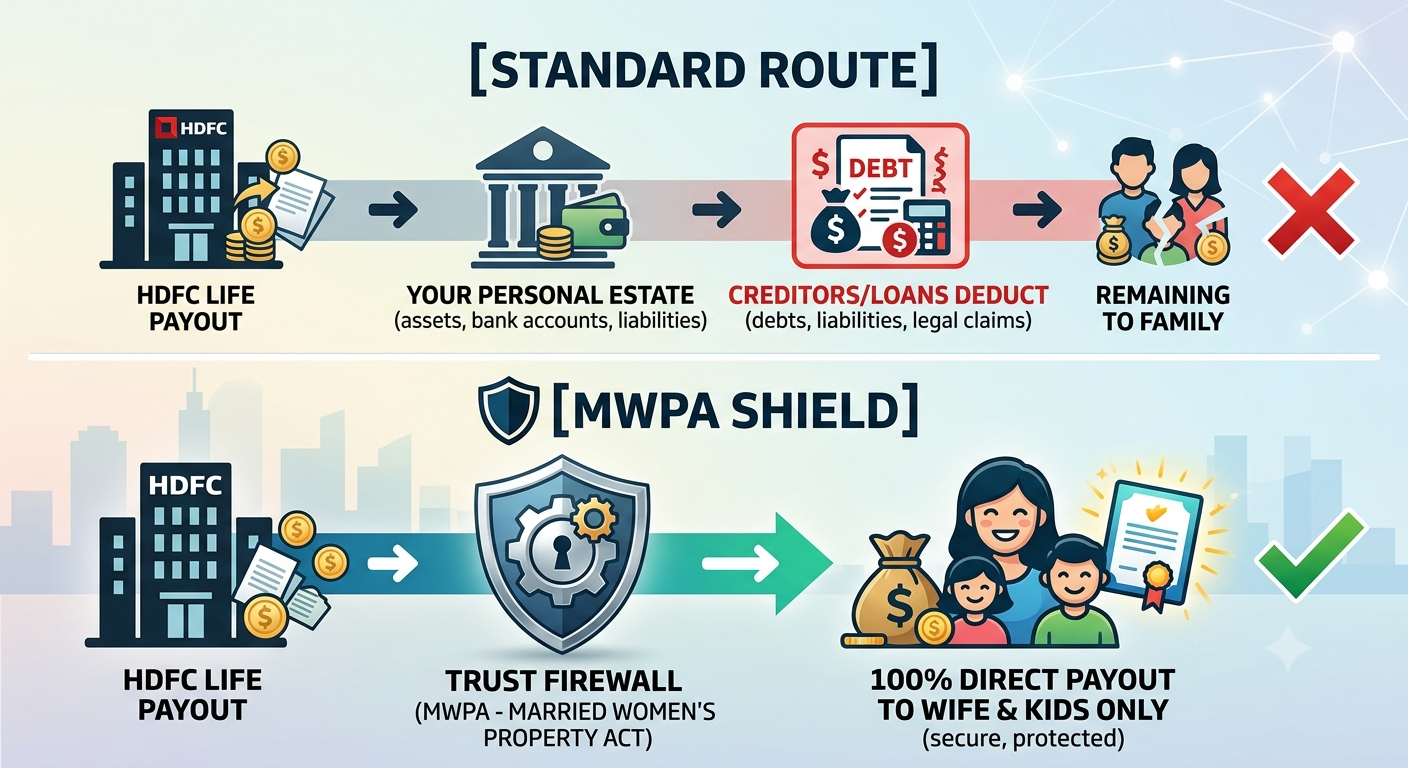
Vanakkam! When we take a life insurance policy, we assume a nominee automatically guarantees total safety for our family. However, in the business and professional world, if there are active bank loans, business liabilities, or personal debts, creditors can legally seize a standard insurance payout before it ever reaches a grieving family.
Thankfully, you can use an unbreakable legal shield using Section 6 of the Married Women’s Property Act (MWPA) right inside your HDFC Life policy to ensure your hard-earned money goes exactly where it belongs.
The MWPA Security Architecture: How It Works
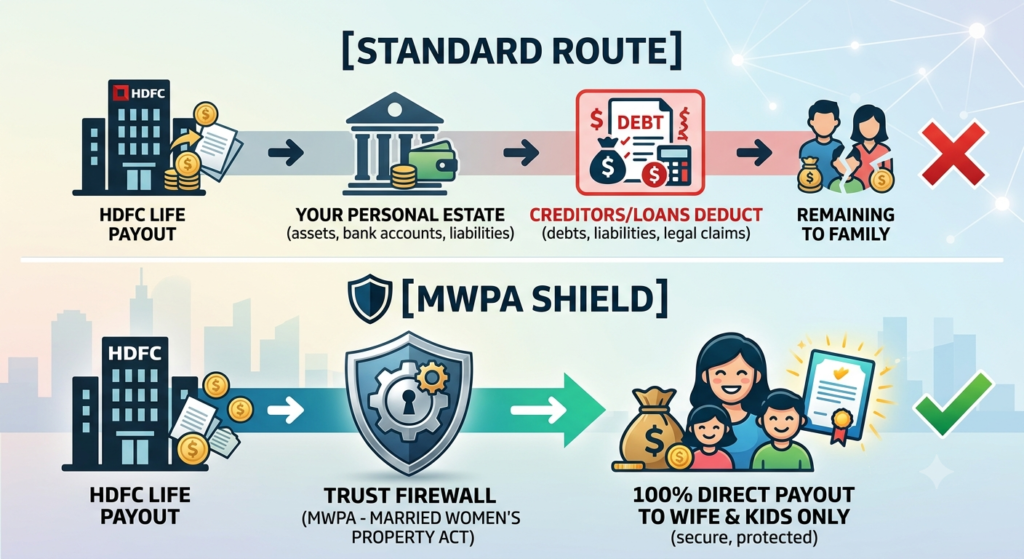
To understand why this works, think of it as changing the routing path of your financial data. Instead of flowing through your general estate, the money bypasses all external systems.
📋 The Step-by-Step Breakdown
- The Vulnerability of a Standard Nominee: In a regular insurance policy, a nominee acts merely as a receiver, meaning the cash pool legally merges with your general estate upon your absence. If there are outstanding dues, the courts must prioritize clearing those debts using your estate’s assets, leaving your family unprotected.
- The MWPA Trust Activation: When you apply for a fresh policy and sign the simple MWPA addendum, the policy is instantly transformed into an independent trust. This structure creates a permanent legal firewall between your personal liabilities and the insurance proceeds.
- The Immediate Exclusion of Creditors: Because the policy is owned by a trust for the exclusive benefit of your family, no court, bank, business creditor, or tax department can attach or claim this money. Your business debts cannot legally cross this firewall, keeping your household security completely intact.
- The Strict Beneficiary Restriction: Under Section 6 of the MWP Act, the beneficiaries can only be your wife, your children, or both. You cannot name your parents, siblings, or partners as beneficiaries under this specific structure, keeping the circle of protection highly focused.
- The Irrevocable Lock: Once this policy is active, it cannot be altered, canceled, or surrendered by you for a cash loan without the explicit consent of the beneficiaries. This ensures that even if you face severe financial pressure or business bankruptcy later in life, your family’s future safety net cannot be compromised.
- Zero-Cost Implementation: Activating this incredibly robust asset protection framework requires absolutely no extra premium, legal fees, or complex registration procedures. You simply fill out the one-page MWPA addendum form simultaneously with your core application paperwork.
Quick Comparison:
Standard Policy vs. MWPA Shield Policy
| Feature | Standard Life Insurance Policy | MWPA Shielded Policy |
| Legal Owner of Payout | Your general estate | An independent legal trust |
| Can Bank Creditors Claim It? | Yes, if you have active business or personal loans | No, completely immune to all attachments |
| Who Can Be a Beneficiary? | Anyone (Parents, Friends, Partners) | Only Wife and/or Children |
| Policy Control | You can fully alter or take loans against it | Locked exclusively for the family’s welfare |
| Setup Cost | Nil | Nil |
The Ideal Checklists: Who Must Use This Framework?
If you fall into any of the following professional categories, adding the MWPA shield to your financial plan isn’t optional—it’s an absolute necessity:
- Business Owners & Startups: If you have taken working capital loans, cash credits, or machinery overdrafts.
- Independent Professionals: Salaried techies, consultants, or freelancers carrying high-value home loans or personal liabilities.
- Sole Proprietors & Partners: Where personal assets are directly linked to the survival and liabilities of the business entity.
The law prevents misuse of insurance policies by husbands and protects the interests of wives and children from creditors, except in cases of fraudulent intent. In summary, Section 6 of the Married Women’s Property Act, 1874, ensures that life insurance policies effected by a husband for his wife or children are legally protected as a trust,
Securing your family’s future shouldn’t leave room for legal loopholes. By spending just two minutes signing an MWPA addendum, you ensure that your love and financial protection reach your wife and children with 100% certainty.