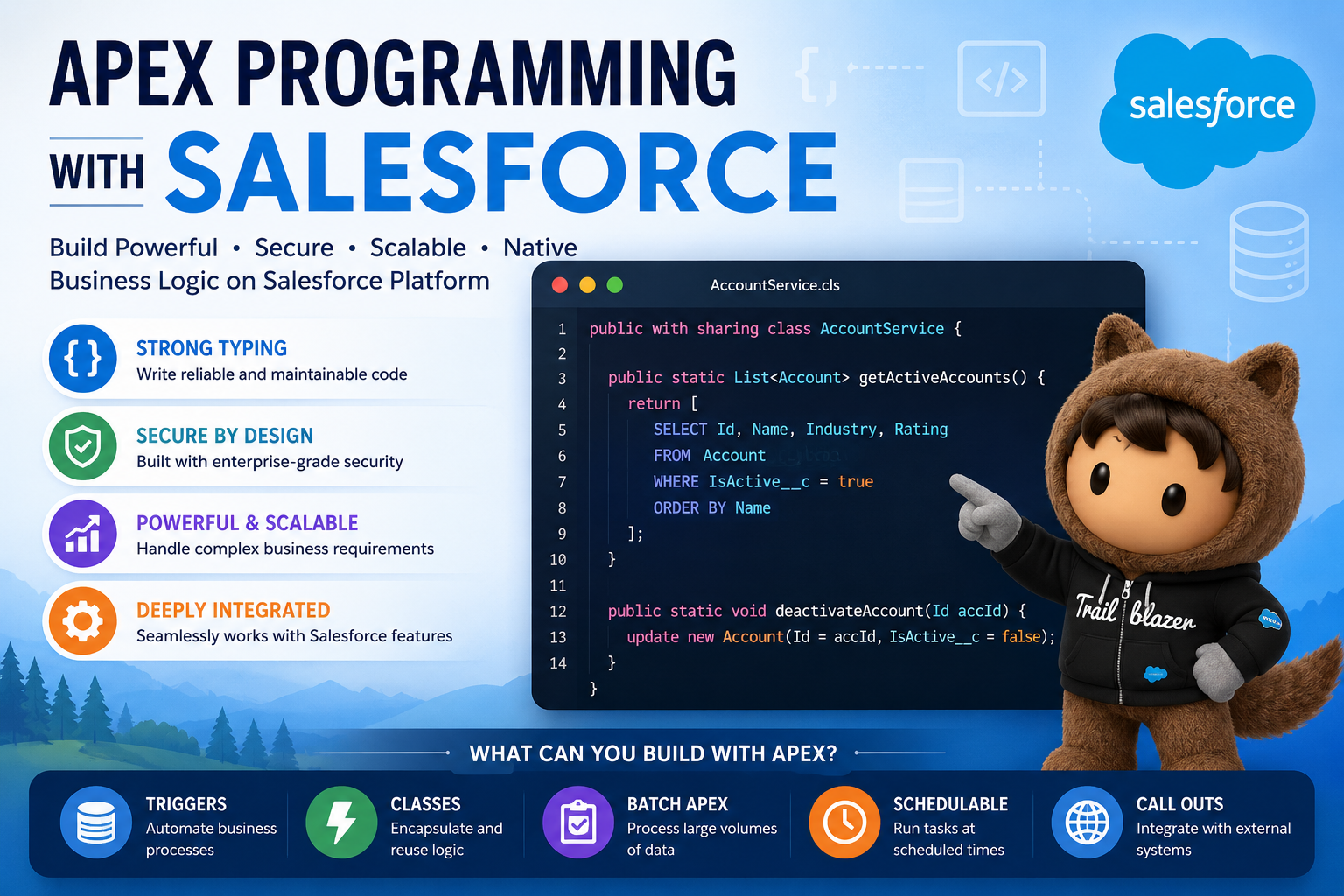
Recently, I reached a significant milestone in my professional development journey by completing an intensive Apex certification course. This training, curated and delivered by Deepika Khanna via My Tutorial Rack, was more than just an exam preparation—it was an architectural deep dive into the foundations of the Salesforce platform.
The Learning Philosophy
Under the expert guidance, the curriculum focused on shifting from “writing code” to “designing systems.” We prioritized the three pillars of robust, scalable Apex development:
- Encapsulation: Ensuring data integrity by properly structuring class access.
- Inheritance & Polymorphism: Utilizing
virtualclasses andoverridemethods to create flexible, extensible code. - Collection Mastery: Implementing efficient Map structures for high-performance data convergence.
A Tri-Partite Approach to Development
This learning process was unique because it utilized a collaborative model to ensure architectural precision:
- Expert Instruction: Instructor provided the essential theoretical framework and project-based scenarios.
- Hands-on Implementation: I translated these concepts into functional code within the Developer Console.
- Architectural Validation: I integrated Gemini as an AI collaborator to provide real-time debugging, syntax validation, and architectural guidance.
Debugging the Architecture: Insights
The most profound learning moments occurred while troubleshooting. Below are the key architectural resolutions from my development log:
| Technical Challenge | Root Cause | Architectural Resolution |
| Illegal Assignment | Attempting to extend a non-virtual class. | Defined the parent class as virtual to enable proper inheritance. |
| Compiler Cache Issues | Unsaved dependencies causing saving loops in the Developer Console. | Implemented a “Close and Re-open” workflow to force clean compilation. |
| Map Syntax Errors | Incorrect assignment operator (=>) usage. | Standardized syntax to Map<String, String> mp = new Map<String, String>{'key' => 'value'}. |
Conclusion
By combining the industry-tested curriculum course with real-time AI-assisted validation, I have significantly accelerated my proficiency in Apex. This certification has bolstered my ability to design clean, debuggable, and scalable solutions—skills I am now directly applying to the ongoing enterprise projects here at SureshBiztech.