Bridging the Gap: How We Built a Unified Supply Chain and Recruitment Ecosystem in Salesforce

A detailed technical case study infographic titled 'Technical Case Study: Unified Supply Chain & Recruitment Ecosystem (PR 4) - The Nexus Global Ecosystem'. The image splits horizontally into 'Before' and 'After' transformation zones. The top 'Before' panel illustrates disconnected operations: a 'Logistics Silo' containing fragmented maps and paper shipping manifests, an central 'Operational Gap' icon showing broken chain links and misaligned puzzle pieces representing manual driver allocations, and a 'Recruitment Silo' with separate HR email queues and isolated spreadsheets causing business communication lag. A bold blue arrow labeled 'System Architecture Transformation' points downward to the 'After' panel. The bottom 'After' panel showcases a multi-tiered Salesforce solution built on a light blue grid background: An 'Ironclad Relational Data Model' diagram outlining lookups from Accounts and Cargo down through Positions and Candidates, ensuring a single source of truth. An 'Automated Personnel Allocation' workflow detailing record-triggered flows that automatically generate job roles when cargo capacity is flagged. A 'Security & Visibility' schematic explaining Field-Level Security restrictions where sensitive compensation data is visible to an HR Manager but hidden from a Logistics Operator. An 'Executive Command Center Dashboard' wireframe previewing real-time corporate business intelligence analytics, featuring an Asset Pipeline Summary pie chart, a Recruiting Pipeline Allocation gauge chart, and a Human Capital Liability Ledger bar chart. A dark navy banner spans the bottom margin with the text: 'Built by Suresh - Master of Commerce & Salesforce Architect'
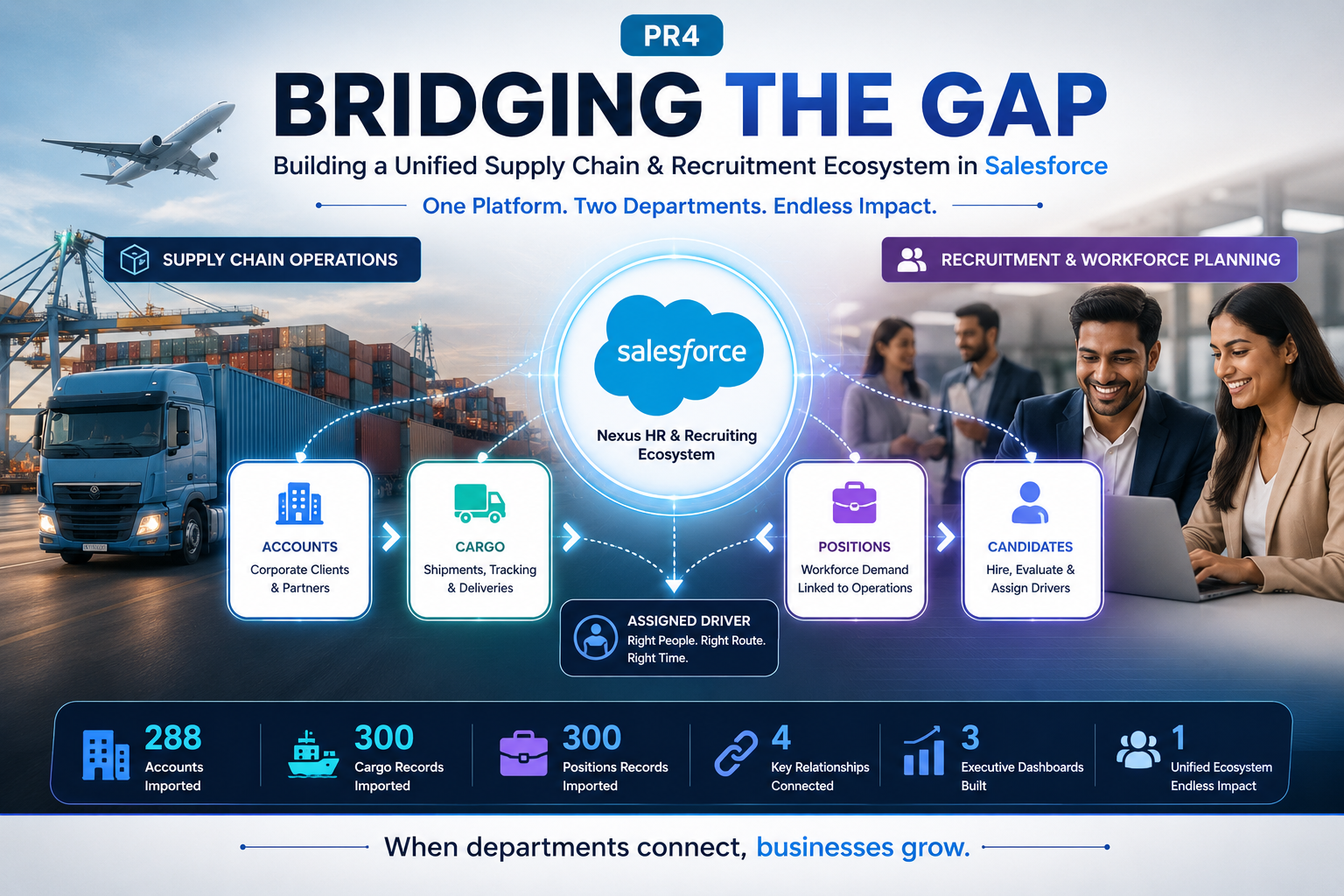
This document serves as the formal technical specification and deployment blueprint for the Nexus Global Ecosystem (PR 4). This architecture builds a unified corporate solution by integrating core B2B Logistics tracking with an automated Human Resources Recruitment system directly within Salesforce.

By establishing a circular relational data structure, the platform ensures that human capital procurement directly supports physical supply chain operations.

1. Executive Summary & Business Use Case

The Problem

Historically, enterprise operations functioned in detached silos. The Logistics division managed freight transit schedules, while the HR division tracked talent acquisition independently. When high-value cargo operations expanded, there was zero system visibility into whether qualified personnel (such as fleet drivers) were actively hired or allocated to those routes. This lack of integration caused severe logistics backlogs, fulfillment delays, and operational inefficiencies.

The Solution

We engineered a cross-functional, relational ecosystem inside Salesforce. By structurally linking Client Accounts, Transit Cargo Manifests, and an end-to-end Recruiting Application (Positions & Candidates), we established a single source of truth. The platform ensures that open logistics constraints automatically generate human capital requisitions, providing senior executives with an integrated operational matrix.


2. System Architecture & Relational Data Model

To enforce data integrity across distinct business units, the schema utilizes a combination of standard Salesforce components and custom-engineered data structures:

Object Topology

  • Accounts (Standard Object): Represents corporate B2B clients booking cargo capacity.
  • Cargo (Custom Object – Cargo__c): Houses individual shipping manifests, transit parameters, and unique tracking identifiers.
  • Position (Custom Object – Position__c): Tracks job vacancies and specialized heavy-freight roles required to fulfill specific shipment routes.
  • Candidate (Custom Object – Candidate__c): Stores applicant profiles, verification fields, and confidential financial salary expectations.

Structural Relationships

  • Account to Cargo (Lookup): Links corporate clients to their active shipments, building transactional histories per account.
  • Cargo to Position (Lookup): Connects personnel vacancies directly to active freight tracking numbers, mapping recruitment needs to concrete assets.
  • Position to Candidate (Lookup): Connects job seekers to open requisitions, allowing recruiters to filter viable candidates by active requirements.
  • Cargo to Candidate (Lookup): Establishes the final operational link by mapping a hired candidate directly to a Cargo record as the assigned driver.

3. Mass Data Migration & Ingestion Strategy

To test system scalability while honoring developer sandbox resource constraints, a multi-phase data load was executed.

Ingestion Volume Metrics

  • Account Records: $288$ records mapped by corporate client names.
  • Cargo Records: $300$ unique asset records tracked via automated alphanumeric manifests.
  • Position Records: $300$ vacancy records mapped to corresponding operational roles.

Ingestion Execution Lifecycle

  1. Parent Extraction: Because child records require parent relationships to link successfully, a Salesforce extraction report was executed to retrieve the newly generated 18-character Cargo IDs (e.g., a018W00000XyZ123).
  2. Relational Spreadsheet Mapping: The extracted Cargo IDs were mapped directly into the Linked_Shipment__c column of the Position CSV file using spreadsheet lookups to guarantee immediate relational integrity.
  3. Data Volume Calibration: Operating under a strict 5.0 MB data storage limit (with 400 KB baseline usage), the 300-row record configuration batches (~2 KB per standard record) were successfully ingested via the Data Import Wizard, bringing total space utilization to a stable ~20% threshold.
  4. The 2-Row Sanity Test: To protect the org against schema errors or picklist value drops, a miniature 2-row test batch was loaded to audit layout behaviors, dependency parameters, and visible record links prior to full mass execution.

4. User Interface & Security Layer Configurations

Dynamic Layouts & Component Visibility

  • Dynamic Forms Migration: Upgraded static record detail layouts into modern Lightning Dynamic Forms to remove interface bloat and increase user processing speed.
  • Conditional Field Visibility: Implemented strict conditional visibility filters on the Cargo record interface. The field Reason_for_Delay__c is programmatically hidden from view unless the Shipping_Status__c picklist matches the value “Delayed”.

List View Optimization Matrix

  • Landing Configuration: Replaced unconfigured default “Recently Viewed” screens by engineering an enterprise “All Active Cargo” view as the default pinned interface.
  • Column Array: Brought vital operational parameters forward into primary horizontal view columns: Cargo Tracking Number, Shipping Status, Client Name (Account Lookup), and Assigned Driver.

Security & Field-Level Access

  • PII Hardening: To safeguard highly sensitive Candidate compensation records, Field-Level Security (FLS) was restricted.
  • Profile Differentiation: The Expected_Salary__c currency field was set to Visible for System Administrators and HR Managers, but explicitly restricted to Hidden for warehouse personnel under the custom Logistics Operator profile.

5. Enterprise Business Intelligence & Analytics

To deliver actionable operational visibility to executive leadership, a high-fidelity analytics panel was constructed by aggregating data rows into grouped reporting matrices:

Dashboard Metrics

Asset Pipeline Summary Matrix (Summary Report): Groups active cargo lines by current tracking status to evaluate delivery compliance rates across all 288 B2B corporate clients.

Recruiting Pipeline Allocation (Donut Chart): Tracks the real-time fulfillment state of the 300 open Position roles, exposing recruitment bottlenecks across shipping lines.

Human Capital Liability Ledger (Horizontal Bar Chart): Measures total organizational operational expenses by calculating the sum of Budgeted_Salary__c broken down by specific job designations.


6. Project Implementation Log (Audit History)

PhaseMilestone DescriptionPrimary Objects InvolvedData Ingested / Actions TakenTechnical Goal Achieved
01App Shell ConstructionApp ManagerCreated Custom App: Nexus HR & RecruitingEstablished dedicated workspaces for HR and operations teams.
02Core Database ProvisioningCargo, Position, CandidateProvisioned custom metadata schemas and descriptionsReplaced fragmented files with localized database cabinets.
03Relational Cross-LinkingAll EntitiesConstructed bidirectional Lookups between objectsEnabled cross-department relationship indexing and deep tracking.
04Security & Layout EnforcementUser Profiles & FieldsConfigured FLS restrictions and Dynamic Form rulesShielded sensitive financial/PII data points across operations.
05Bulk Operational MigrationAccounts, Cargo, PositionsUploaded 288 Accounts, 300 Cargo lines, and Position manifestsStress-tested relational database links with enterprise data batches.
06Command Center ReportingReports & DashboardsEngineered summary reports and chart dashboardsTransformed static table rows into live C-suite business insights.

Get a high-quality PDF copy of the Nexus Global Ecosystem (PR 4) architectural blueprint, including data schemas and implementation logs for offline reference.

Leave a Reply

Your email address will not be published. Required fields are marked *